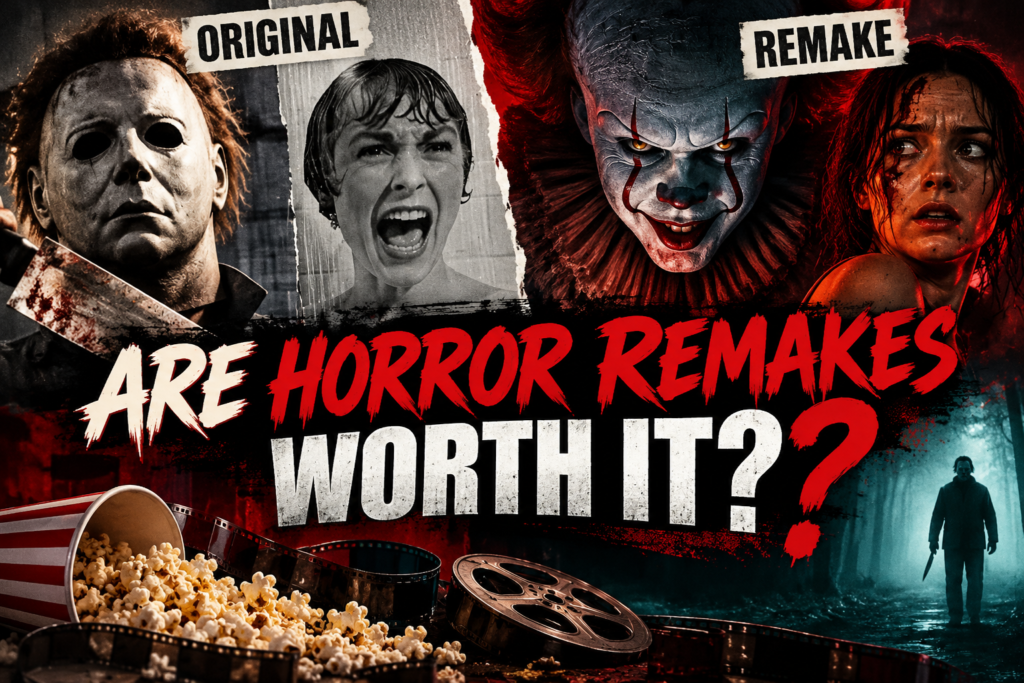
No genre remakes itself more — or argues about it louder. The case for, the case against, and the one test that settles it.
Every October, the same fight breaks out in horror fandom: somebody announces a remake of a film that was already perfect, and half the audience hears opportunity while the other half hears sacrilege. No other genre remakes itself this often — horror is cheap to produce, titles carry decades of recognition, and fear can theoretically be sold twice. So the slate’s question deserves a real answer, not a reflex: are horror remakes worth it?
The case against: the photocopy problem
Start with the prosecution’s best evidence. Gus Van Sant’s Psycho (1998) remade Hitchcock shot for shot and proved that copying a masterpiece frame by frame produces a corpse, not a film — the scares were all there and none of them worked, because suspense lives in decisions, not compositions. The 2000s remake boom had a different flaw: it was a business model wearing a director’s chair, cycling through The Texas Chainsaw Massacre, Friday the 13th and A Nightmare on Elm Street with handsome, hollow efficiency.
The Elm Street remake is the boom’s perfect autopsy. Per SlashFilm‘s reporting, the 2010 film grossed $117 million worldwide against a $35 million budget — a genuine hit — yet it sits at 14% with critics and, in Robert Englund’s own assessment, “the remake was premature.” It made money and stalled the franchise anyway: nearly two decades on, Freddy remains stuck in a rights tangle, per SlashFilm, with no follow-up. A remake can win its opening weekend and lose its property forever, because it gave a new generation no reason to care about the next one.
The case for: when the original left something on the table
Now the defense, opening with the strongest exhibit in all of horror. John Carpenter’s The Thing (1982) is a remake — of The Thing from Another World (1951) — and per MovieWeb, it was panned on release and barely broke even before being reappraised as a classic. Carpenter understood that the 1951 film had discarded the best idea in John W. Campbell Jr.’s novella Who Goes There?: the alien does not rampage, it imitates, perfectly, and the horror is not knowing whether the man beside you is a man. The source had been filmed around, not filmed. Add Rob Bottin’s still-unmatched practical effects, and you get the remake every other remake is measured against.
David Cronenberg’s The Fly (1986) makes the same argument in a different key: the 1958 original is a charming B-picture; Cronenberg found in it a tragedy about disease, obsession and a body betraying its owner, and made the definitive version. Zack Snyder’s Dawn of the Dead (2004) kept Romero’s mall and rebuilt everything else — sprinting zombies, a military clock, an opening ten minutes that still play like a heart attack. None of these films photocopied. Each located the unmined core of its source and dug somewhere new.
The middle path: the argument remake
Between photocopy and reinvention sits the most interesting category: the remake as argument. Fede Álvarez’s Evil Dead (2013) stripped Raimi’s cabin film of its slapstick and played possession as addiction and withdrawal — a real thesis, executed with punishing practical gore. Per TheWrap‘s reporting, it opened at No. 1 with an estimated $26 million on a budget of around $17 million, on its way to roughly $97 million worldwide — proof a remake with a point of view can sell the argument, not just the title.
Luca Guadagnino’s Suspiria (2018) argued the opposite direction: where Dario Argento’s 1977 original is a fever of color and prog-rock, Guadagnino muted the palette, stretched the runtime and set the coven story inside divided Berlin’s political guilt. This was devotion, not commerce — he first saw the film at 14 and, as Nerdist quoted him, “immediately started to dream about making my own version of it.” Audiences split and the box office was modest, but nobody calls it unnecessary: it is a film about its original as much as it is one.
Even the legacy-sequel era is this debate in disguise. Halloween (2018) — half remake, half erasure — grossed $255 million worldwide by arguing that forty years of sequels had buried the one story worth telling, Laurie’s trauma; yesterday’s feature made the fuller case. Rob Zombie’s Halloween films argue back from the other side. You can reject either thesis — you cannot call either one an accident.
The verdict
So here is this desk’s test, three questions. Did the original leave its best idea unfilmed — a source unmined, an effect unbuildable, a theme unsayable in its era? Does the new filmmaker have an argument with the original, not just affection for it? And does a new era change what the story means — the way imitation paranoia meant something new in 1982, or addiction in 2013? A remake passing even two of the three is worth making. One passing none is a photocopy.
Are horror remakes worth it? As a business, obviously — the receipts above say so, even for the failures. As art, they are worth it exactly when they behave like The Thing rather than a licensing exercise: when somebody looks at a beloved film and sees the one door its makers never opened.
Verdict: Worth it — conditionally. A horror remake earns its existence when it films the idea the original left behind or argues with the original out loud; a remake that only repeats is worth nothing, no matter what it grosses.
The 247 Take — The remake is not horror’s disease; it is horror’s oldest tradition, running from The Thing back through every ghost story ever whispered twice. Judge each one by whether it found a new door in an old house — and stop forgiving the ones that just repaint the walls.
More movie news at CelebnMusic247.com.