The R&B star walked out of a London court a free man — eight months hanging over his head for a year after the bottle attack a judge called “plainly dangerous.”
By Theon Lewis — “The Superfan” — CelebnMusic247
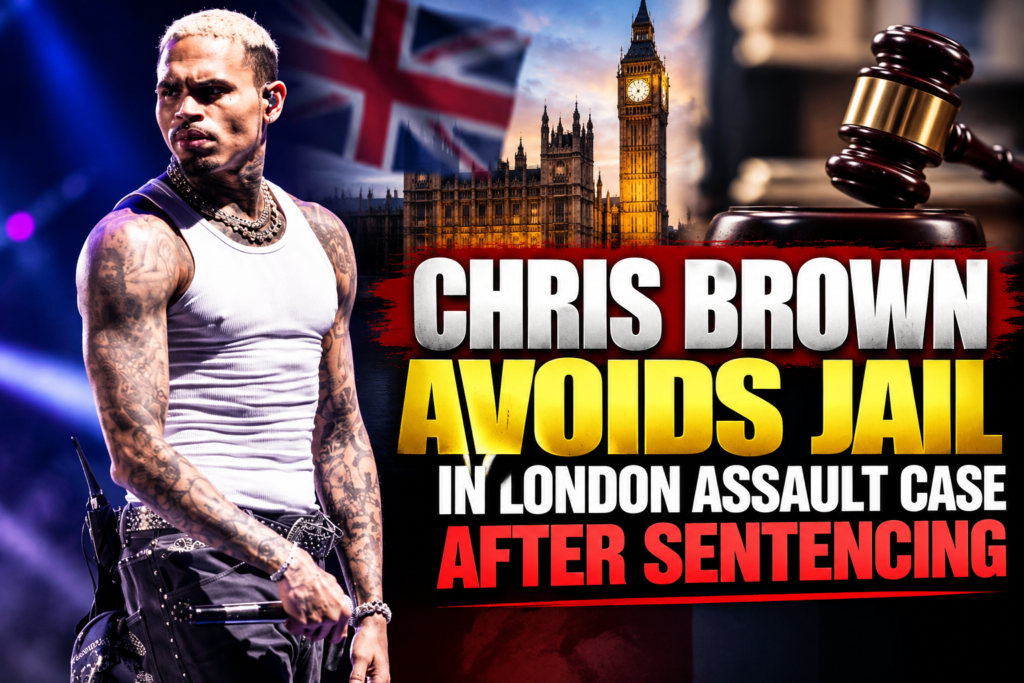
Chris Brown will not go to prison — but for the next twelve months, one wrong move could put him there. The 37-year-old singer was sentenced Monday at Southwark Crown Court in London to eight months in custody, suspended for twelve months, for his part in a violent attack on music producer Abe Diaw inside Tape nightclub in Mayfair in the early hours of February 19, 2023.
Brown’s co-defendant, his vocal coach Omololu Akinlolu, 40, received four months, also suspended for twelve months. Both men had pleaded guilty to affray back in July, and each must pay £1,500 toward prosecution costs. Because the sentences are suspended, neither man goes to jail today — but any new conviction inside the suspension window would likely trigger the custodial term on top of whatever the new offence brings.
Judge Tony Baumgartner did not soften the facts. The attack, captured on CCTV that the Metropolitan Police released on sentencing day with a warning about violent scenes, lasted no more than about twenty seconds in a crowded VIP area — short, the judge said, but “intense.” Brown initiated the violence and struck Diaw repeatedly with a glass bottle, including twice on the head, which the judge called “plainly dangerous” and said risked significantly more serious injury. Diaw was treated in hospital for head trauma, musculoskeletal problems, tenderness around his neck and abdomen, and reduced movement in his left knee. Akinlolu, who carried no bottle, was found to have punched and kicked Diaw while he was on the ground and pursued him as he tried to get away — an “active participant” with a “significant” role, though less culpable than Brown.
The judge was equally direct about who Brown is: he played the leading role, and he was not entitled to special treatment because of his fame, commercial success or professional standing. Brown’s two earlier violence convictions, from 2009 and 2013, were noted but treated as old. What helped him: a long period of bail compliance, a pre-sentence report assessing his risk of reoffending as low, his status as a father of four, stable employment and charitable work. The judge also pointed to the Sentencing Act 2026, which presumes sentences of twelve months or less will be suspended, and said no extra conditions were necessary.
Outside court, the scene belonged to the fans. Brown left to loud cheers wearing a baseball cap, sunglasses and a face covering, stopped to sign an autograph, and rode away in a black vehicle — later posting an Instagram story video from the car, giving a thumbs up.
A suspended sentence is still a custodial sentence, as the judge reminded the room, and Brown now carries one through October 2027, with a tour-worthy career on one side of the line and eight months on the other.
The sentence also set off an immediate debate back in the States. On “The Low Down,” the TMZ and New York Post panel show, the question was blunt: did Chris Brown get off easy? Some on the panel argued that avoiding jail is not sufficient given Brown’s checkered past. Others pressed on the part of the story the courtroom version leaves open — what started the confrontation, including what Diaw, a former friend of Brown’s, said to him before it turned violent — and the discussion turned to Brown’s mental health: he was diagnosed with bipolar depression and PTSD more than a decade ago. The show put the hard version of the question on the table: whether there is a point where repeated bad behavior stops being chalked up to mental illness.
The 247 Take — Chris Brown has been given every second chance celebrity can buy, and Monday’s sentence is structured like the last formal one: freedom, with a timer on it. The judge said fame bought him nothing — but fame is also what fills the room with cheering fans outside a courtroom where a man described being hit in the head with a bottle. Both things are true, and the next twelve months decide which one defines the story.
Sources: BBC News | TMZ — “The Low Down” debate coverage (tmz.com)