
Rating: 9.5/10
CelebnMusic247.com and CelebnMovies247.com reports Christopher Nolan didn’t just adapt The Odyssey. He resurrected one of the greatest stories ever told and transformed it into a cinematic experience that demands to be seen on the biggest screen possible.
After years of anticipation, Nolan’s The Odyssey has finally arrived, and it’s every bit as massive, emotional, terrifying, and visually staggering as fans hoped it would be.
Shot entirely with IMAX cameras, this isn’t simply another blockbuster. It’s an event. It’s the kind of film that reminds audiences why theaters still matter.
If Lawrence of Arabia, Gladiator, Jaws, and The Lord of the Rings somehow collided, the result might look something like The Odyssey.
And that’s exactly why this film works.
Christopher Nolan Turns Greek Mythology Into a Modern Cinematic Spectacle
The original Odyssey survived for thousands of years because it was passed from one generation to the next through oral storytelling long before it was ever written down.
Nolan understands this better than most filmmakers.
Instead of modernizing Homer’s epic, he honors it.
He preserves its poetry, its mythology, and its emotional core while using every tool modern filmmaking has to offer.
Watching The Odyssey in 70mm IMAX feels less like seeing a movie and more like participating in a storytelling tradition that began thousands of years ago.
This isn’t simply a retelling.
It’s a continuation.
And Nolan is the only filmmaker working today with the technical ambition and creative authority to pull it off.
The Three-Hour Runtime Flies By
At nearly three hours, The Odyssey should feel exhausting.
It doesn’t.
The film moves with remarkable confidence.
Every chapter of Odysseus’s journey unfolds naturally, carrying viewers from one breathtaking sequence to the next without losing momentum.
The pacing is one of the film’s greatest strengths.
There’s always another island to explore.
Another monster to confront.
Another impossible obstacle standing between Odysseus and home.
Even the quieter moments carry emotional weight.
The only slight weakness comes during the early return to Ithaca, where the momentum briefly slows. Compared to the relentless intensity of the ocean sequences, those scenes initially feel less immersive.
Fortunately, Nolan uses those quieter moments to build toward one of the strongest final acts of his career.
And when everything comes together, the payoff is extraordinary.
Matt Damon Delivers One of the Best Performances of His Career
At the center of this epic is Matt Damon, who completely disappears into the role of Odysseus.
His performance is exceptional.
He doesn’t play Odysseus as an untouchable mythical hero.
Instead, he portrays a man burdened by war, haunted by loss, and exhausted by the impossible expectations attached to his legendary status.
Damon brings vulnerability to a character often defined by strength.
You don’t just admire him.
You feel his pain.
You experience his fear.
And you desperately want him to find his way home.
Anne Hathaway’s Penelope Is the Emotional Heart of the Film
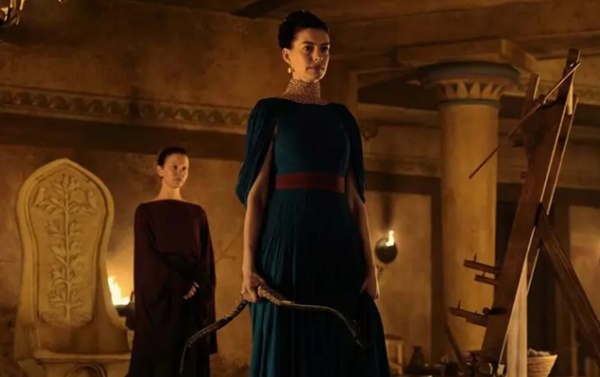
Anne Hathaway may have delivered the performance of her career.
From the moment she appears on screen, Penelope becomes far more than the wife waiting for her husband’s return.
She becomes the emotional anchor of the entire story.
Hathaway brings intelligence, resilience, and quiet heartbreak to every scene.
Her struggle against the growing threat inside Ithaca transforms the kingdom into something worth fighting for.
There’s a depth and maturity to her performance that feels awards-worthy.
And once again, Hathaway proves that her collaborations with Christopher Nolan consistently bring out some of her strongest work.
Tom Holland and Robert Pattinson Create an Unexpectedly Powerful Dynamic
Tom Holland’s Telemachus provides the film’s emotional coming-of-age story.
His modern delivery occasionally feels slightly out of place against the ancient setting, but Holland quickly settles into the role.
His search for answers about his father adds genuine emotional stakes to the story unfolding back in Ithaca.
Meanwhile, Robert Pattinson is absolutely fantastic.
His portrayal of one of Penelope’s most dangerous suitors is unlike anything we’ve seen from him before.
He’s manipulative, intimidating, and impossible to ignore.
Every scene involving Pattinson carries an unsettling sense of danger.
And that tension elevates the entire Ithaca storyline.
Christopher Nolan’s Secret Weapon? Horror
This may be the biggest surprise in the entire film.
Christopher Nolan should absolutely direct a horror movie.
Because some of the most unforgettable sequences in The Odyssey aren’t the battles.
They’re the nightmares.
The Cyclops sequence is pure horror filmmaking.
Instead of presenting the creature as a simple mythological obstacle, Nolan transforms it into a terrifying cinematic monster.
The sequence feels closer to a classic creature feature than a traditional fantasy film.
And it’s brilliant.
Then comes Circe’s island.
Without revealing too much, Nolan embraces body horror in ways audiences have never seen from him before.
Using practical effects and makeup, he creates one of the most disturbing and unforgettable sequences of the decade as Odysseus’s crew undergoes a horrifying transformation.
It’s grotesque.
It’s mesmerizing.
And it’s impossible to look away.
The Ocean Sequences Are Some of the Most Beautiful Ever Filmed
The real star of The Odyssey might be the ocean itself.
The storms are breathtaking.
The naval battles are overwhelming.
The sound design is so immersive that it almost becomes a physical experience.
At times, the audio borders on being too intense.
But that’s also the point.
Nolan wants you to feel the crashing waves.
He wants you to hear the terror.
He wants you to experience the chaos alongside the crew.
And it works.
Every frame feels massive.
Every wave feels dangerous.
Every storm feels alive.
Zendaya’s Athena Is the Film’s Most Underrated Performance
While much of the attention will rightfully focus on Damon, Hathaway, Holland, and Pattinson, Zendaya quietly delivers one of the film’s most impactful performances.
Her version of Athena avoids spectacle.
Instead, she serves as Odysseus’s spiritual compass.
Her presence provides moments of wisdom, compassion, and guidance throughout the journey.
It’s a more restrained performance than many viewers might expect, but it’s incredibly effective.
Christopher Nolan Has Created the Epic of the Modern Era
Very few films live up to impossible expectations.
The Odyssey somehow exceeds them.
It’s visually stunning.
It’s emotionally devastating.
It’s terrifying.
It’s adventurous.
And it’s unlike anything else currently playing in theaters.
This is blockbuster filmmaking operating at the highest possible level.
Christopher Nolan has taken one of the foundational stories of Western literature and transformed it into a cinematic experience that feels both ancient and entirely new.
The result is nothing short of extraordinary.
Final Verdict: The Odyssey isn’t just one of the best movies of 2026. It’s one of Christopher Nolan’s greatest achievements and a new benchmark for epic filmmaking.