
Suzanne Collins wrote Coriolanus Snow’s origin as an interior rot; Francis Lawrence filmed it as a romance with teeth — and the difference is the whole argument.
By Becky — The Cinephile — CelebnMusic247
Some prequels exist to answer questions nobody asked. The Ballad of Songbirds and Snakes exists to answer the only question the Hunger Games ever really posed: how does a person become President Snow? Suzanne Collins’ 2020 novel answers it from inside Snow’s skull — 500-plus pages of a vain, frightened, status-obsessed eighteen-year-old narrating his own compromises in real time. Francis Lawrence’s 2023 film, running 157 minutes, answers it from outside — watching Coriolanus watch Lucy Gray Baird, and mistaking surveillance for love.
The book’s Snow is worse — because you can hear him think. Collins writes the novel in tight third person glued to Coriolanus’ perceptions, and the effect is quietly horrifying: every kindness is a transaction (he feeds Lucy Gray because a fed singer performs better; he protects her because her survival is his scholarship), every affection is audited against the Snow family name. The book’s signature horror is banal — he is not a monster under the bed, he is a landlord’s son doing arithmetic. Tom Blyth’s film performance is excellent, but cinema cannot narrate the arithmetic; it can only show the face doing it, which inevitably softens him. Readers finish the novel despising Snow with comprehension. Viewers finish the film understanding him with sympathy — a meaningful, arguable difference.
Lucy Gray belongs to the camera; in the book, she is a locked room. Collins famously never gives us Lucy Gray’s interiority — she exists only as Snow sees her, which is why her final vanishing works as literature: the girl he could never possess becomes the ghost he can never confirm. On screen, Rachel Zegler solves the locked room by performing through it — the Covey’s musical numbers, staged full and long, give Lucy Gray a public self the book withholds. The film’s most faithful choice is also its boldest: it does not decide her fate either. She walks into the trees in both versions, and both versions leave Snow firing at shadows.
The Games themselves are the clearest split. The novel’s 10th Hunger Games are squalid by design: a broken-down arena, tributes kept in a zoo, a mentor’s death by snake muttation, cruelty as bureaucratic improvisation. The film visualizes that squalor faithfully — the Capitol zoo, the bombing, the drone gifts — and then, in its final act, compresses what the novel lingers on: Snow’s peacekeeper exile in District 12, the Covey’s slow fracture, the murder of Mayfair Lipp and its cover-up. Compression is not betrayal, but it changes the temperature: the book’s last hundred pages are a man choosing damnation in installments; the film’s last act is a man discovering it at speed.
The mentor becomes the mirror. The film’s expansion of Casca Highbottom (Peter Dinklage) and Dr. Gaul (Viola Davis) is flattening in the book, incandescent on screen: Dinklage’s morphling-addicted dean, the accidental author of the Games idea, hating his own creation and the boy who resembles him — that is a film invention in emphasis, and it earns its place. Gaul, a footnote of menace in prose, becomes the movie’s thesis statement: the state does not need Snow to be evil, only to be teachable.
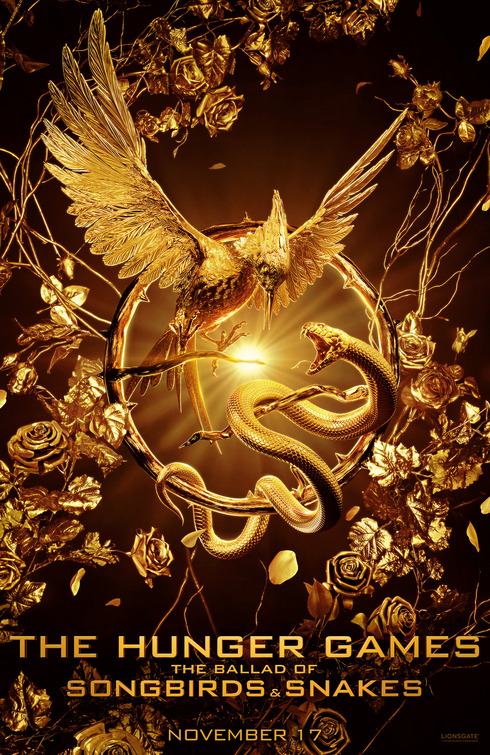
A note on the iconography. Theatrical posters sell the binary honestly: serpent and songbird, locked in gold. The book’s cover is colder — the same pairing rendered as specimen. Both are telling the truth about the material: this is a story about a boy who looked at a singer and saw a snake-handling problem to be managed, and a girl who looked at a Capitol boy and, possibly, saw exactly what he was from the beginning.
Scoring the adaptation. Fidelity of event: high — plot point for plot point, the film is honest. Fidelity of feeling: contested — the novel’s interior rot is untranslatable, and the film knows it, choosing romance and spectacle as compensation. As a standalone film: a success. As Collins’ argument: a beautiful dilution.
The Trailers
The 247 Take — Read the book for the rot; watch the film for the romance; then argue with someone about which Snow is scarier. That argument is the prequel working exactly as designed.
More movie news at CelebnMusic247.com.
Sources: The Ballad of Songbirds and Snakes — novel by Suzanne Collins (Scholastic Press, 2020); film directed by Francis Lawrence (Lionsgate, 2023). Comparative feature — all judgments are the author’s.