

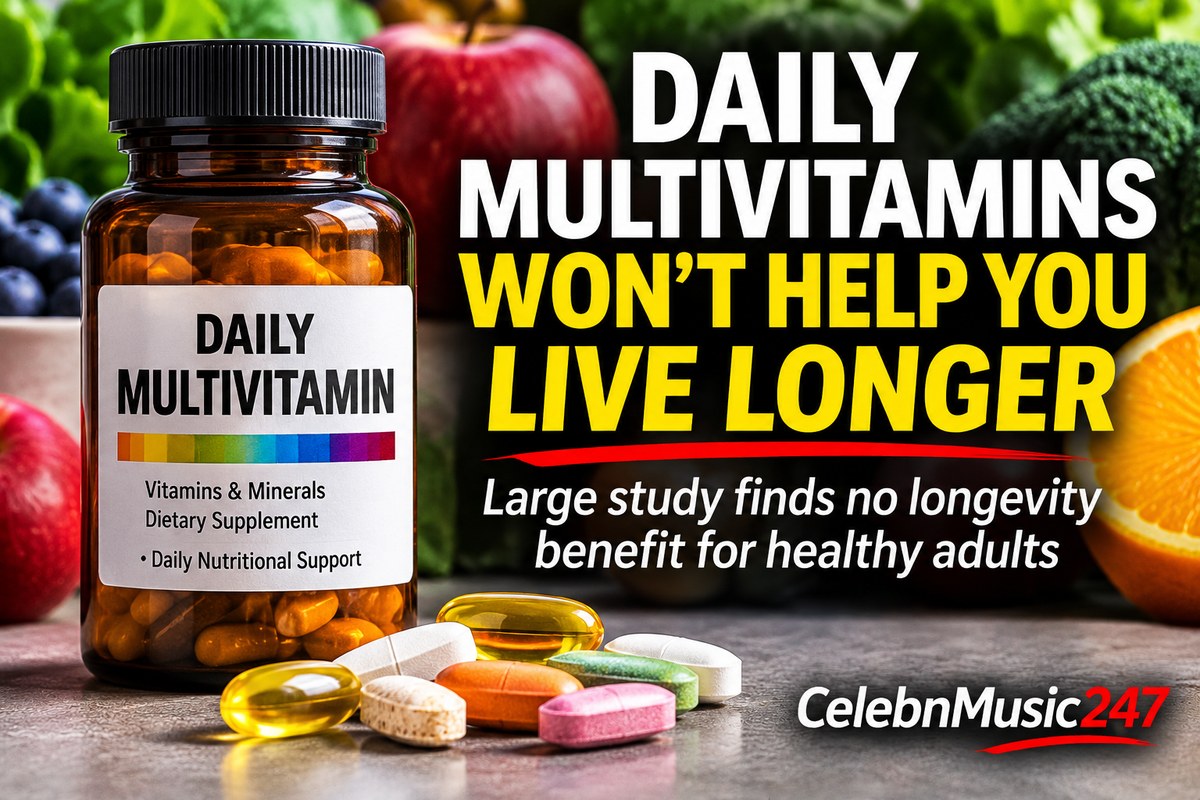
Healthline’s top story of the day is the supplement aisle’s least favorite finding: in nearly 400,000 adults followed for decades, the daily multivitamin did nothing for lifespan.
By Dr Ron — The Wellness Desk, CelebnMusic247
One in three American adults takes a daily multivitamin, most of them hoping it quietly buys them time. Healthline made the evidence its top story on October 30 — “Daily Multivitamins Won’t Help You Live Longer, Study Finds” — and the study underneath that headline is about as large as nutrition research gets.
What the study actually found
Researchers at the National Cancer Institute analyzed data from 390,124 generally healthy U.S. adults drawn from three major cohorts, followed for up to 27 years, in work published in JAMA Network Open, per SciTechDaily’s report on the study. Over the follow-up period, more than 164,000 deaths were recorded. The finding was flat: daily multivitamin use was not associated with a lower risk of death overall, and there were no meaningful differences in deaths from cancer, heart disease or stroke.
One number deserves careful reading rather than a scary headline. In the early years of follow-up, people who reported daily multivitamin use showed a slightly higher risk of death — about 4 percent — than non-users, per SciTechDaily. The researchers did not conclude that multivitamins cause harm; that early difference is the kind of association large observational studies surface for many reasons, and the study’s overall conclusion was simpler: taking a multivitamin to improve longevity is not supported by the data. The U.S. Preventive Services Task Force has separately concluded that the evidence is insufficient to recommend multivitamins for preventing heart disease or cancer.
What this does not say
This study looked at generally healthy adults without major chronic illness at the start. It was not a study of people with diagnosed vitamin deficiencies, and it does not speak to anyone whose clinician has prescribed a supplement for a specific reason. Folic acid in pregnancy, to take the standard example, remains recommended. Healthline’s own framing is the balanced one: the research challenges a specific belief — that a daily multivitamin extends life for healthy adults — not every use of every supplement.
What the evidence keeps pointing to instead is unglamorous: diets built on vegetables, fruits, legumes and whole grains consistently show the links to longer life that a pill has not, per SciTechDaily’s summary of the findings.
This article reports what the study found; it is not medical advice, and anyone weighing a change to their own supplements should make that call with their own doctor, not a headline.
The 247 Take — The Wellness Desk’s rule is to tell you what a study shows and stop there, and this one shows something worth knowing before your next checkout: for healthy adults, the daily multivitamin is a habit, not a lifespan strategy. The grocery list is doing the work the bottle promised.
More health news at CelebnMusic247.com.
Sources: Healthline Daily News (Healthline’s October 30 top story: “Daily Multivitamins Won’t Help You Live Longer, Study Finds”) | SciTechDaily (the National Cancer Institute study in JAMA Network Open: 390,124 adults, follow-up of more than 20 years, no mortality benefit, no differences in cancer, heart disease or stroke deaths, the early-follow-up 4 percent figure, and the dietary-pattern context)