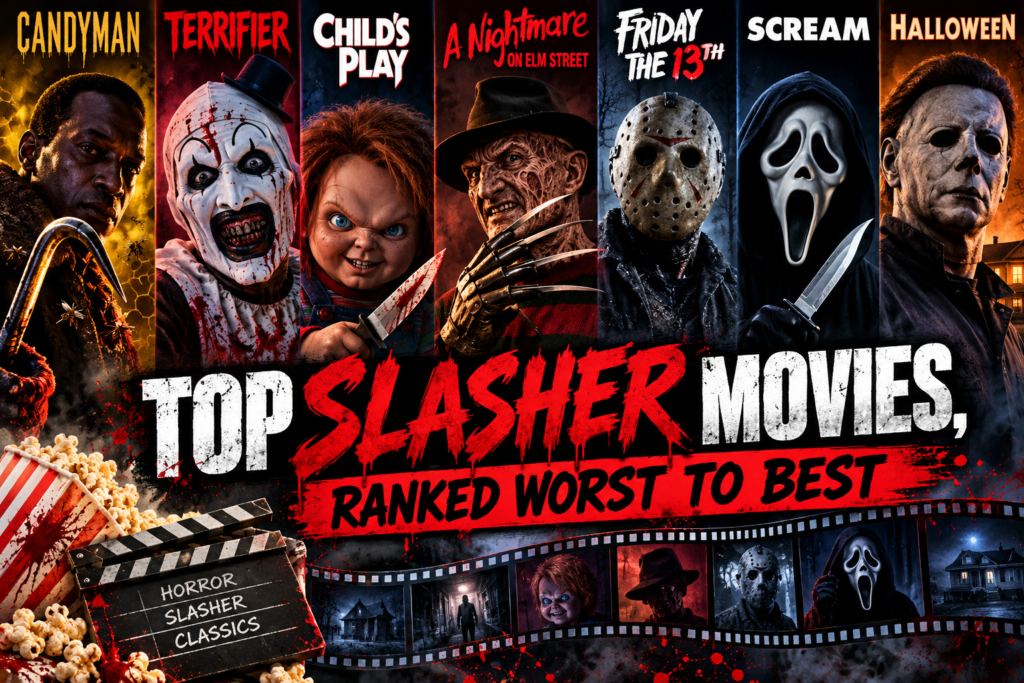
Knives out: fifty years of masked killers, final girls and one Christmas Eve phone call, argued down to the ten that built the genre.
By The Cinephile — CelebnMusic247
The slasher is horror’s most democratic genre: a knife, a mask, a group of young people making terrible decisions, and one survivor standing at dawn. It is also the genre where ranking gets personal fastest, because everyone has a killer they grew up fearing. This is our ten — the films that invented the rules, broke them best, or pushed them somewhere genuinely new. Counting down:
10. Terrifier 3 (2024)
The newest film on this list, and the proof the slasher still lives outside the studio system. Damien Leone’s Christmas-set threequel turned David Howard Thornton’s Art the Clown into a mainstream horror icon on an indie budget, powered by practical gore so extreme it became the marketing. It sits last here because extremity is its whole argument — but as a phenomenon, and as a final-girl showcase for Lauren LaVera’s Sienna, it earned its seat.
9. Child’s Play (1988)
The slasher’s great high-concept gamble: what if the killer is two feet tall and sitting on your child’s bed? Tom Holland turned a possessed Good Guy doll into a franchise engine, and Brad Dourif’s voice work as Chucky — the dying killer Charles Lee Ray, trapped in plastic — gave the genre its only truly funny monster. It works because it plays the mother’s terror completely straight.
8. Candyman (1992)
Bernard Rose took Clive Barker’s story to Chicago’s Cabrini-Green projects and made the slasher film as urban legend — and as social autopsy. Tony Todd, summoned by saying his name five times in a mirror, is the genre’s most elegant killer: soft-spoken, romantic, and terrifying precisely because he barely has to move. No other slasher aches like this one.
7. Friday the 13th (1980)
Everyone misremembers this film — the killer is not Jason, who drowned as a boy, but his mother Pamela, avenging him across Camp Crystal Lake. Sean S. Cunningham’s summer-camp body count is cruder than its peers, but Tom Savini’s effects changed what audiences expected a murder to look like, and the template it sold — isolated place, guilty teenagers, anniversary massacre — ran the decade.
6. Black Christmas (1974)
Four years before Halloween, Bob Clark built the slasher’s skeleton in a sorority house at Christmas: the killer’s-eye opening, the obscene phone calls, the police who arrive at the wrong conclusions. Its ending — the calls traced, the house supposedly cleared, the phone ringing again — is still the coldest in the genre. Every slasher since owes it rent.
5. The Texas Chain Saw Massacre (1974)
Purists argue whether this is a slasher at all; we say Leatherface’s dinner party settles it. Tobe Hooper shot a sun-blasted nightmare that feels like documentary footage of hell, with a final girl — Marilyn Burns’ Sally, laughing hysterically in the back of a pickup — who does not triumph so much as escape. Almost bloodless, utterly unbearable.
4. A Nightmare on Elm Street (1984)
Wes Craven’s masterstroke was moving the slasher somewhere locks cannot help: sleep. Freddy Krueger — Robert Englund, burned, gloved in razor blades, killing the children of the parents who burned him — turned dreams into the genre’s most inventive murder sets, and Heather Langenkamp’s Nancy into the rare final girl who studies the rules and fights back with engineering.
3. Psycho (1960)
The proto-slasher, and still the most audacious structure in horror: Alfred Hitchcock murders his leading lady in the shower halfway through and hands the film to Anthony Perkins’ Norman Bates, all boyish charm and mother issues. No Psycho, no slasher grammar — the knife, the voyeurism, the killer as psychology instead of monster all start at the Bates Motel.
2. Scream (1996)
Craven again, this time dissecting the genre he helped build. Kevin Williamson’s script gave the slasher self-awareness without surrendering the scares: Drew Barrymore’s opening sequence is the best first fifteen minutes in horror, Ghostface is terrifying because anyone can be under the mask, and Neve Campbell’s Sidney Prescott is the final girl grown fully human — traumatized, funny, and done running.
1. Halloween (1978)
John Carpenter made it for roughly $300,000 and made it forever. Michael Myers — the Shape, a white mask and a pair of coveralls, evil without a motive anyone can use — stalks Jamie Lee Curtis’ Laurie Strode through one long suburban night while Donald Pleasence’s Loomis races to arrive in time. Carpenter’s own two-finger score, Dean Cundey’s gliding camera, almost no blood and endless dread: this is not just the best slasher ever made, it is the blueprint the other nine are still tracing.
Verdict: Halloween is still the slasher all others answer to — Scream argues with it brilliantly, Elm Street dreams beyond it, but nobody has ever beaten Carpenter for pure, patient, suburban terror.
The 247 Take — Notice what the top five share: patience. The modern slasher keeps reaching for louder gore — Terrifier 3 proves there is a real audience for it — but the kills that live forever are the ones a director made you wait for, in a doorway, in a reflection, in a ringing phone.
More movie news at CelebnMusic247.com.
Sources: Halloween trailer — Scream Factory; Terrifier 3 trailer — Cineverse / Bloody Disgusting. Film facts are the desk’s rankings knowledge cross-checked against studio and festival coverage.