
CelebnMusic247.com and CelebnSports247.com reports, when Paul Skenes takes the mound, baseball fans expect one thing: dominance.
Triple-digit fastballs. Overpowering strikeouts. The kind of electric performances that have turned the Pittsburgh Pirates ace into one of the biggest stars in Major League Baseball.
That’s why Tuesday night’s outing against the Miami Marlins left fans asking a question no one expected to be asking in 2026:
What’s happening to Paul Skenes?
The Pirates’ franchise pitcher exited after just five innings and 65 pitches in a 2-0 loss to Miami. While the final score grabbed headlines, it was something else that immediately caught the attention of baseball fans across social media.
The radar gun.
Paul Skenes’ Fastball Velocity Is Trending in the Wrong Direction
For the first time in his career, Skenes’ four-seam fastball averaged just 95.7 mph.
Even more surprising?
He didn’t throw a single pitch that reached 97 mph.
For most major league pitchers, a 95 mph fastball would be considered elite. For Paul Skenes, it’s a dramatic departure from the pitcher who routinely overpowered hitters with upper-90s velocity.
The numbers tell the story:
- 2024: 98.8 mph average fastball
- 2025: 98.1 mph average fastball
- 2026: 96.9 mph average fastball
- Latest start: 95.7 mph average fastball
That’s a significant decline for a pitcher who built his reputation on elite velocity and devastating stuff.
The Statistics Paint an Even More Concerning Picture
Velocity isn’t the only number moving in the wrong direction.
Against the Marlins, eight of the 21 batters Skenes faced made hard contact. His swing-and-miss rate also fell to a career low.
Those numbers would be concerning for any pitcher. Moreover, Paul Skenes won the Cy Young Award in 2025 and posted a sub-2.00 ERA in his two MLB seasons.
This season, Skenes owns a 3.88 ERA through 25 starts, a noticeable increase from the incredibly high standard he established during his first two years in the league.
The Pirates Say It’s Not an Injury
Naturally, concerns about an injury quickly spread across social media.
However, Pirates manager Don Kelly downplayed those concerns and insisted that Skenes’ early exit wasn’t related to any physical issue.
Instead, Kelly said he believed bringing in a fresh arm gave Pittsburgh the best opportunity to compete.
Interestingly, Skenes agreed with the decision.
“If I were the manager, I’d probably do it, too. It is what it is.”
That response may calm some fears, but it hasn’t completely eliminated the questions surrounding his declining velocity.
Baseball Fans Are Starting to Panic
If there’s one thing baseball fans know, it’s that declining velocity often leads to uncomfortable conversations.
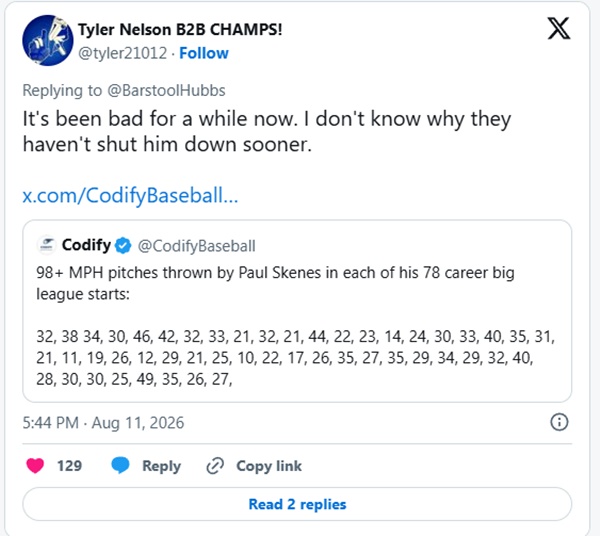
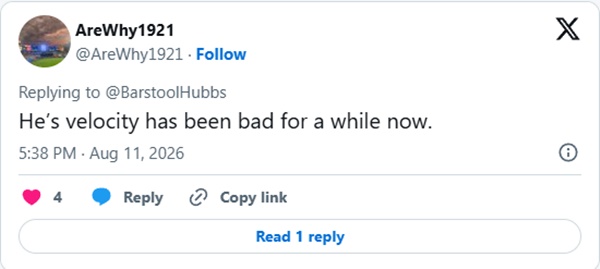
Social media quickly filled with reactions from concerned Pirates fans.
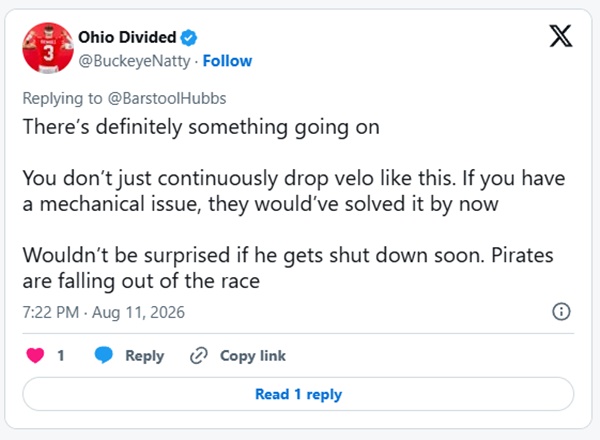
Some believe a mechanical adjustment could explain the drop.
Others aren’t so optimistic.
Several fans suggested that the organization should consider shutting him down before a more serious issue develops.
While fan reactions can sometimes be exaggerated, the concerns aren’t completely unfounded.
Pitching velocity doesn’t usually decline this dramatically without an underlying explanation.
However, Is It Fatigue, Mechanics, or Something More? Paul Skenes
There are several possible explanations.
Pitchers can lose velocity because of:
- Mechanical changes
- Workload management
- Fatigue
- Minor injuries
- Arm soreness
- Changes in conditioning
The problem is that none of those possibilities have been confirmed.
Until the Pirates provide additional information, fans are left analyzing radar-gun readings and searching for clues.
The Good News for Pittsburgh
Despite the declining velocity, Paul Skenes remains one of the most talented pitchers in baseball.
Even with a fastball averaging in the mid-90s, his arsenal still ranks among the best in Major League Baseball.
His command, pitch movement, baseball IQ, and ability to attack hitters remain elite.
But for a pitcher who seemed almost superhuman just a year ago, the recent trend is impossible to ignore.
The Pirates Have a Huge Decision to Make
The Pittsburgh Pirates now face a difficult challenge.
Do they continue sending their ace to the mound while monitoring the situation?
Or do they become more aggressive and prioritize long-term health over short-term results?
With the team beginning to fall behind in the playoff race, protecting one of baseball’s brightest young stars may become the organization’s top priority.
One game doesn’t define a season.
One slower fastball doesn’t automatically mean an injury.
But when a pitcher’s velocity continues to decline over several months, fans are going to notice.
And right now, Paul Skenes’ fastball is creating more questions than answers.